
Alcohol in the Death Clock
Alcohol intake is an input of the death clock: the clock adjusts the projected age at death by a calculator weight for the drinking-frequency answer entered, set by the calculator rather than validated as a lifespan effect.
The alcohol tool returns the weight applied to the answer you choose, in years added or subtracted.
Each calculator weight is the calculator’s own choice, because no published result supplies these years: the alcohol analyses described below report health measures for populations. For a full alcohol life expectancy calculator, the death clock result starts from your date of birth, sex and country, then adds the weights for your alcohol answer and your other answers, body mass index included.
- Author
- Jacob V.
How alcohol changes the result
For example, at ‘Moderate, 2 to 3 times a week’, the clock subtracts 1.2 years from the projected age at death.
The 1.2-year adjustment is the calculator’s own weight, not a figure from a study. The reference answer, ‘Rarely, once a month or less’, equals a weight of 0 years. The alcohol weights are defined as fixed lookup values in the calculator, one per answer.
The clock does not read drinks per day or week or the age drinking started, only how often you drink; each answer is a frequency, not a measured dose, and only the heaviest answer names several drinks a day.
What the alcohol analyses measured
The Global Burden of Disease (GBD) 2016 Alcohol Collaborators (Lancet 2018) estimated that overall health loss from alcohol, counted in deaths and disability-adjusted life-years, was lowest at zero alcohol consumption. (GBD 2016 Alcohol Collaborators. Lancet 2018;392:1015–1035)
A disability-adjusted life-year (DALY) is the sum of years of life lost to early death and years lived with disability, as the later GBD 2020 analysis defines it. In the GBD 2016 analysis, one standard drink equals 10 g of pure ethyl alcohol, the unit in which that analysis measures consumption.
The GBD 2016 estimate is evidenced by a systematic review and meta-analysis of relative-risk estimates from 592 studies of alcohol risk. The estimate’s zero point is defined as the minimum of one global risk curve that weights health outcomes by their DALY rates, not a level for each location or person. The same analysis is bounded by its estimates of alcohol use and attributable burden, which cover 195 locations for 1990–2016 and are population estimates, not a personal lifespan estimate.
The later GBD 2020 analysis from the same collaboration (Lancet 2022) found that the modelled alcohol consumption associated with minimum health loss varied by age and region, a finding that does not establish a personal lifespan adjustment (GBD 2020 Alcohol Collaborators. Lancet 2022;400:185–235).
How intake levels are read
The clock reads alcohol in three steps: you choose one of six answers about how often you drink, the clock looks up that answer’s fixed weight, and it adds the weight to your baseline age at death.
- Choose which of the six answers about how often you drink applies to you.
- Find that answer’s fixed calculator weight: each answer equals one weight in years.
- Add the weight to the country-and-sex baseline, the age at death the clock computes from your age, sex and country before it is adjusted by any lifestyle answer.
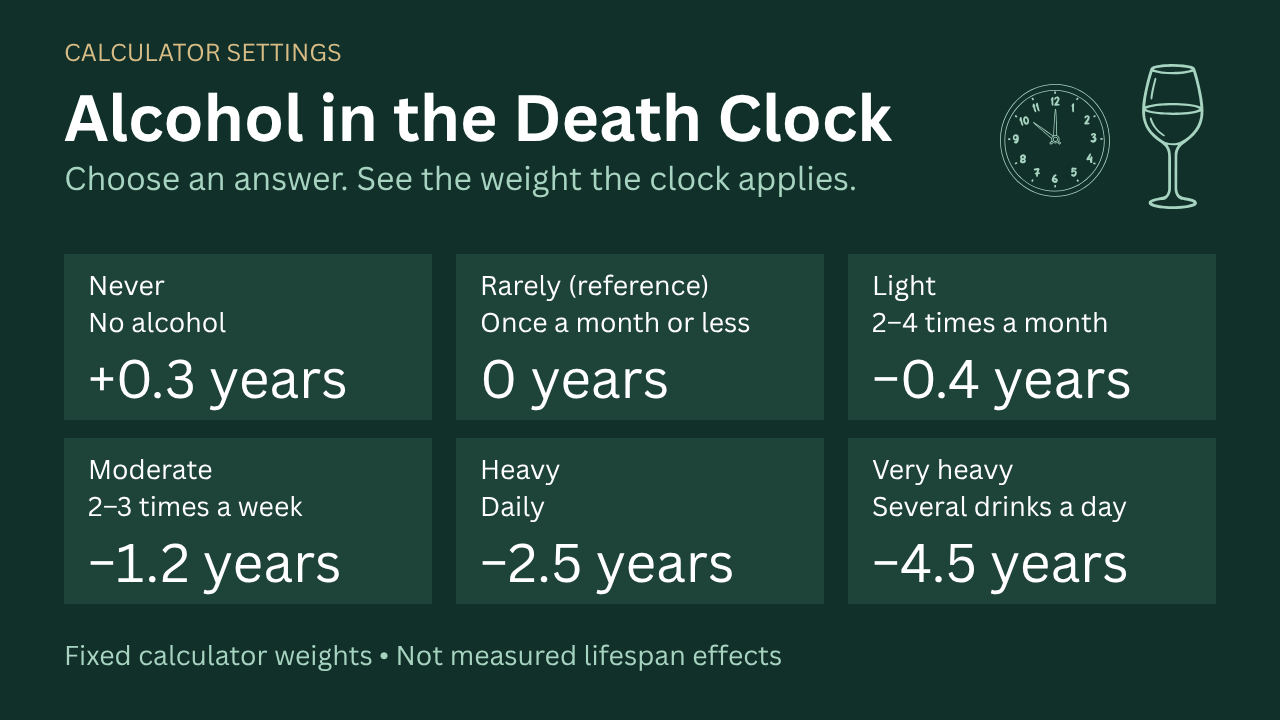
The six answers and the weight the death clock adds for each, in the form’s order:
- Never: the weight equals +0.3 years.
- Rarely, once a month or less: the weight equals 0 years, the reference answer.
- Light, 2 to 4 times a month: the weight equals −0.4 years.
- Moderate, 2 to 3 times a week: the weight equals −1.2 years.
- Heavy, daily: the weight equals −2.5 years.
- Very heavy, several drinks a day: the weight equals −4.5 years.
Every other input the clock reads
Alcohol is one of the calculator’s adjustment inputs.
The inputs page lists every input the clock reads, alcohol among them, with its adjustment.
What the alcohol adjustment does not establish
The alcohol adjustment does not describe any one person’s drinking pattern.
The clock does not check the frequency answer you report: it takes the answer as given. The calculator does not read medical history or past drinking, and in the full result, the other answers and the calculator’s floor and cap on the estimate also affect how far the result moves.